Watch a short briefing
Prices checked 2026-11-11. HomeServStack has no affiliate deals with any vendor named here. Totals below are our calculations from published list prices; they are not vendor quotes. We did not run paid accounts for this article (method).
Short answer: For a one-truck mow route, start with Yardbook’s free plan, and read the fee math before you stay on it. For a growing mow or mixed home-service shop, start with Jobber Connect. For treatments and chemical records as the product, look at GorillaDesk, Service Autopilot Pro, or a RealGreen-class demo — not a generalist that does not name chemical tracking.
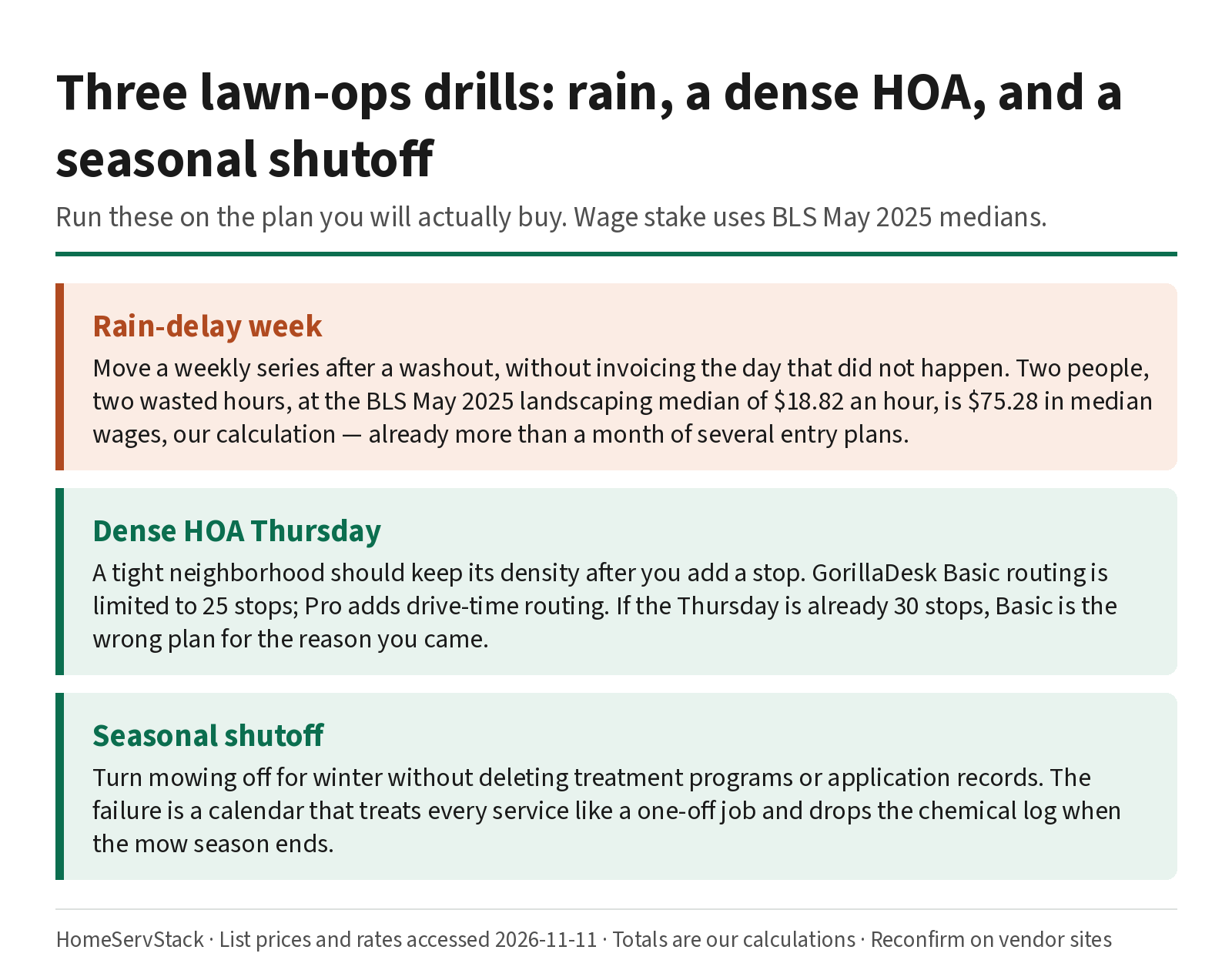
Call this a labeled Wednesday, not a case study. A two-person crew rolls out to a washed-out street because Tuesday’s rain never made it onto the route. The Bureau of Labor Statistics, in its May 2025 Occupational Employment and Wage Statistics, puts the median hourly wage for landscaping and groundskeeping workers at $18.82. Two people, two wasted hours, is $75.28 in median wages on our calculation, before fuel. That is already more than a month of several entry plans in this category.
So here is the argument. Pick lawn care software by whether you run mow routes or treatment programs, and by the meter you pay on — per company, per user, per route, or a license band with a sign-up fee. Routing is one job in the week, not the whole category, and the plan price is often the smallest number in the decision.
The 1% Yardbook fee, and when that fee crosses the $34.99 Business plan, lives in Yardbook vs Jobber. This page is the category map. It is not a cleaning article; the cleaning cluster starts at best scheduling software for cleaning businesses.
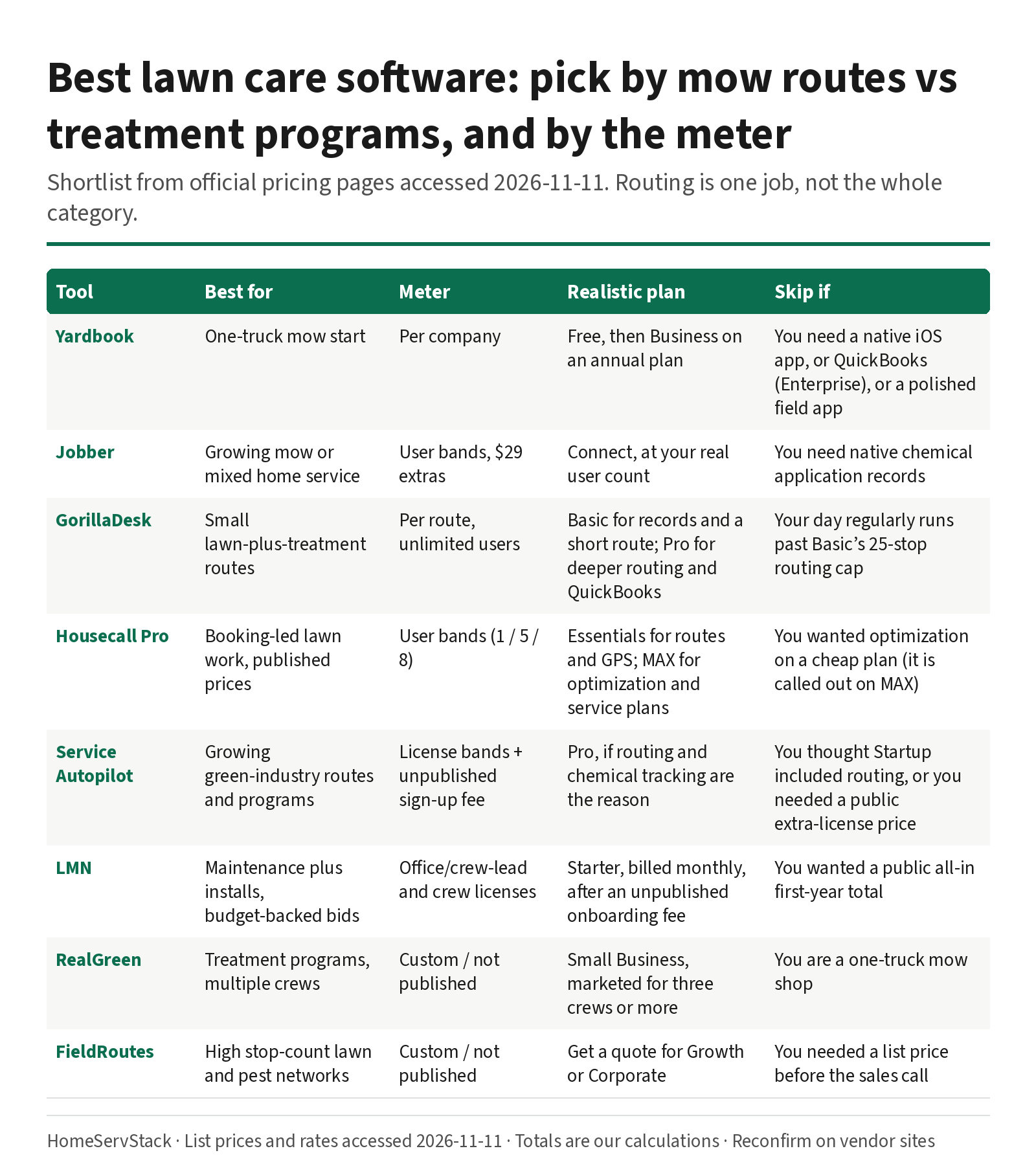
Shortlist at a glance
| Tool | Best for | Meter | Realistic plan | Trial / contract | Skip if |
|---|---|---|---|---|---|
| Yardbook | One-truck mow start | Per company | Free, then Business on an annual plan | Free plan has no time limit; cancel deletes your content | You need a native iOS app, or QuickBooks (that is Enterprise), or a polished quote-to-cash field app |
| Jobber | Growing mow or mixed home service | User bands, $29 extras | Connect, at your real user count | 14-day Grow trial, no card; annual payment is non-refundable | You need native chemical application records |
| GorillaDesk | Small lawn-plus-treatment routes | Per route, unlimited users | Basic for records and a short route; Pro if you need deeper routing and QuickBooks | 14-day trial, no card; month to month, with a freeze option | Your day is regularly longer than Basic’s 25-stop routing cap, and you do not want to pay for Pro |
| Housecall Pro | Booking-led lawn work, published prices | User bands (1 / 5 / 8) | Essentials for routes and GPS; MAX for route optimization and Recurring Service Plans | 14-day MAX trial, no card | You wanted optimization on a cheap plan (it is called out on MAX) |
| Service Autopilot | Growing green-industry routes and programs | License bands + unpublished sign-up fee | Pro, if routing and chemical tracking are the reason | Free trial mentioned; length not stated. Downgrade at end of contract | You thought Startup included routing, or you needed a public extra-license price |
| LMN | Maintenance plus installs, budget-backed bids | Office/crew-lead and crew licenses | Starter, billed monthly, after an unpublished onboarding fee | Demo; onboarding fee amount not published | You wanted a public all-in first-year total, or you are still one truck hoping it will be “about $50” |
| RealGreen | Treatment programs, multiple crews | Custom / not published | Small Business, marketed for three crews or more | Demo; one operator reports being told they were too small | You are a one-truck mow shop |
| FieldRoutes | High stop-count lawn and pest networks | Custom / not published (Request Pricing) | Get a quote for Growth or Corporate | Demo | You needed a list price before the sales call |
What this means: the first three rows will cover most one-truck and small-crew mow shops with published prices. The next rows are the treatment and multi-crew conversation, and two of them will not give you a number until you talk to sales.
Also considered, briefly. ServiceTitan-class platforms sit above the published-price promise and are out of scope here. Aspire-class operational platforms show up in landscaping conversations for larger maintenance companies; we did not put them on the shortlist because we did not independently verify a current public price card for this article. If a vendor blog used the word enterprise next to your one-truck shop, that is marketing, not a recommendation.
Mow routes and treatment programs are different jobs, and they pay on different meters
A mow route lives on density and weather. You want the Thursday HOA loop tight, a rain delay that moves a series without invoicing the washout, and a crew that can see the next stop on a phone. A treatment program lives on the application record: what was put down, at what rate, on which day, and how the program bills across visits. Many shops do both. The software decision still starts by asking which job, if it broke this week, would cost you more.
The National Association of Landscape Professionals, on its industry-statistics page accessed 2026-11-11, cites an industry report putting 2025 landscape-services market size at $188.8 billion, with more than 1.4 million people employed. The same page summarizes NALP’s 2025 Financial Benchmark Study: participating firms — an association survey, not a census of one-truck shops — had a median of 355 customers and generated $14,682 per customer. Those participants are a different scale than Kim’s one-truck mow. Use them as a ceiling on what “typical” means in a trade association, not as your first-year forecast. NALP also says labor costs are expected to rise roughly 20% from now through the end of 2029. Combined with the BLS median wage, that is the stake: a tool that wastes a crew’s morning, or that cannot keep a chemical log, will cost more than a plan-gap of a few dozen dollars.
The framework is work style × size, with the meter in the cell.
| One truck | 2 to 5 people, or 2 routes | 6 to 15 logins, or several routes | Multi-crew treatment, 3+ crews | |
|---|---|---|---|---|
| Mow-route company | Yardbook free, then Business when the fee math says so. Jobber Connect at one user if you already want the field-service app. GorillaDesk Basic if a per-route bill and month-to-month terms fit. | Jobber Connect’s five-user band, or GorillaDesk priced on the routes you actually run. Yardbook stays a per-company card; the login meter is not published. | Jobber Connect on the cheaper band path (ten-user band, then extras). Housecall Pro MAX if you want published optimization and can live with the 8-user band. | Usually you have already left the free plan. Price Jobber’s 15-user band against a green-industry demo. |
| Mixed mow plus some treatments | Yardbook Business lists a multi-step chemical program. GorillaDesk Basic lists material tracking. Jobber does not name chemical tracking. | Same, and check the chemical log in the trial, not the marketing sentence. | Service Autopilot Pro if the program is becoming the product. Confirm licenses and the sign-up fee on a demo. | RealGreen or FieldRoutes if the program is the business; get a quote. |
| Treatment program is the product | GorillaDesk, or a careful Service Autopilot demo. Skip RealGreen if they will not demo a shop your size. | GorillaDesk Pro, or Service Autopilot Pro (routing and chemical tracking start here). | Service Autopilot Pro or Pro Plus; RealGreen Small Business is marketed for three crews or more. | RealGreen-class or FieldRoutes. List prices are custom / not published. |
| Maintenance plus installs, bid from a budget | LMN Starter is marketed at smaller crews, but the published starting price and unpublished onboarding fee are a different conversation than a $49 route. | LMN Starter: 1 office/crew-lead license and 5 crew licenses, billed monthly, after the unpublished onboarding fee. | LMN Professional: 3 office and 15 crew licenses, same onboarding caveat. Extra licenses are “available for a fee,” amount not published. | LMN Enterprise, contact sales. |
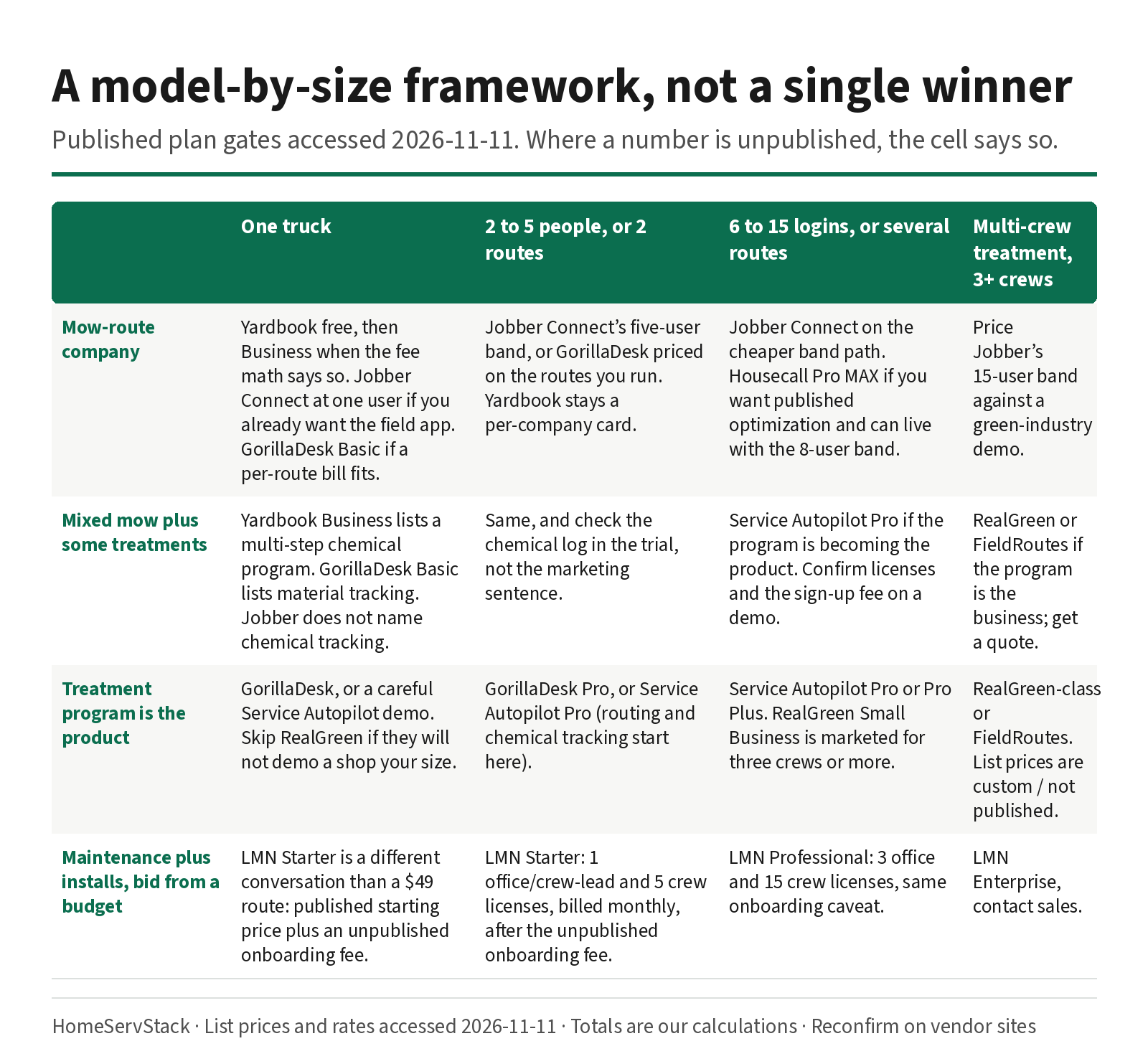
What this means: you can skip rungs. A two-crew mowing company that already quotes renovations can start on Jobber and never touch Yardbook. A fertilizer-and-weed program with three trucks can go straight to a Service Autopilot or RealGreen demo. The table is a map, not a loyalty program.
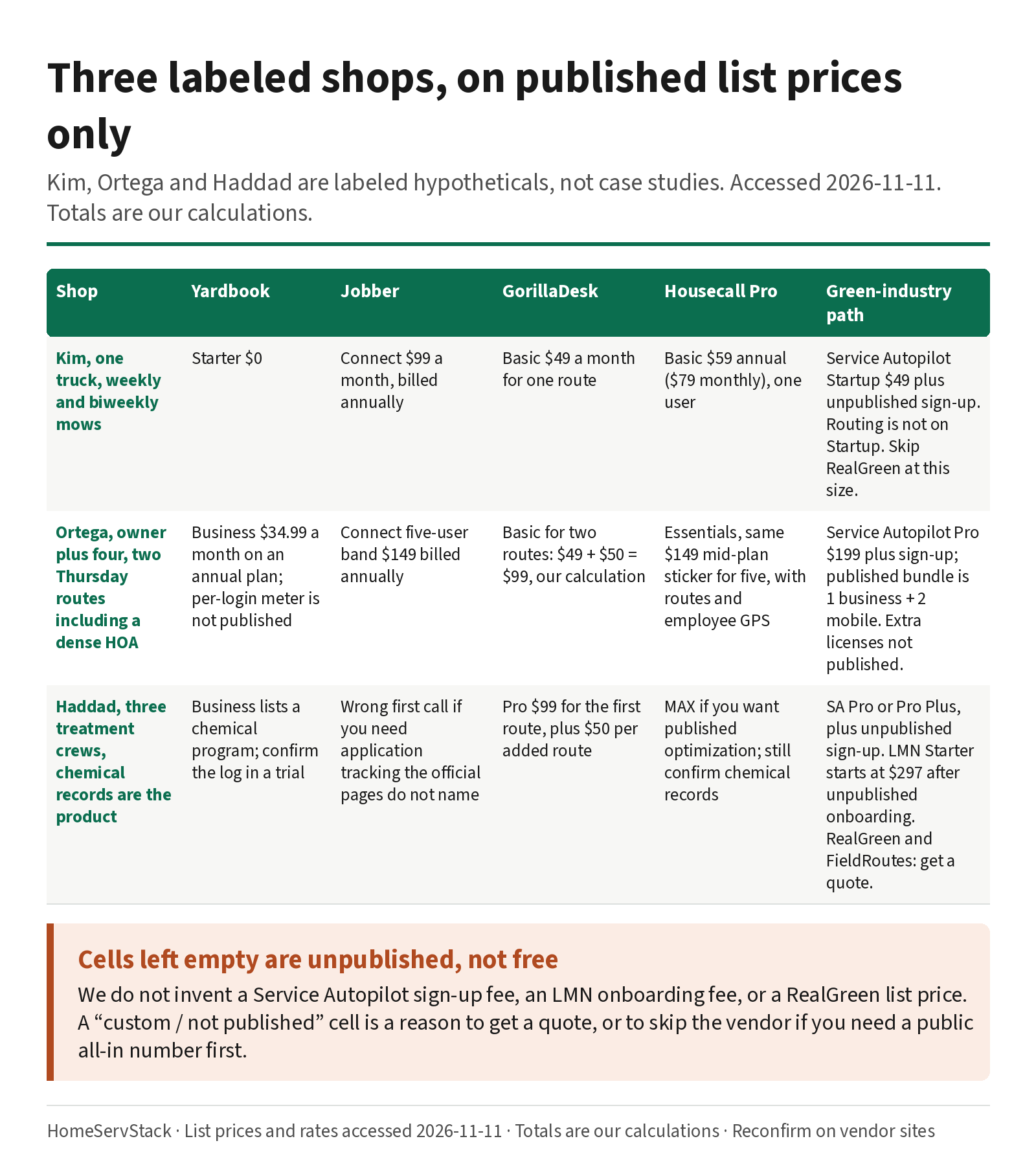
Three labeled shops, on published prices only
Assumptions: list prices accessed 2026-11-11. Jobber and Housecall Pro figures prefer annual billing. Yardbook’s $34.99 and $49.99 are for annual plans; month-to-month rates are not published. Service Autopilot figures are annual rates, each plus a sign-up fee we cannot total. LMN is billed monthly, after an unpublished onboarding fee. GorillaDesk figures are month-to-month for the first route, plus published extra-route rates where we use them. Processing fees are excluded here except as a pointer: the Yardbook 1% crossover is in Yardbook vs Jobber. Totals are our calculations.
Call these labeled shops, not case studies.
Kim, one truck, weekly and biweekly mows. Yardbook Starter is $0. Jobber Connect is $99 a month billed annually. GorillaDesk Basic is $49 a month for one route. Housecall Pro Basic is $59 a month billed annually ($79 month to month), one user. Service Autopilot Startup is $49 plus the unpublished sign-up fee, and it does not include route optimization. Kim should not start on RealGreen; the vendor markets Small Business for three crews or more, and one one-man operator reports being told he was too small for a demo.
Ortega, owner plus four, two Thursday routes including a dense HOA. Jobber Connect’s five-user band is $149 a month billed annually. Housecall Pro Essentials is the same mid-plan sticker for five users, with routes and employee GPS listed on that plan. GorillaDesk Basic for two routes is $49 plus $50, or $99 a month, our calculation from the pricing FAQ (routes 2 and 3 are +$50 each on Basic). Yardbook Business is still $34.99 a month per company, on an annual plan, if the login count they actually need is covered — and that per-login meter is not published, so get it in writing. Service Autopilot Pro is $199 plus the sign-up fee, with one business user and two mobile licenses; extra licenses are custom / not published, so a five-person field roster may not fit the published bundle.
Haddad, three treatment crews, chemical records are the product. Jobber is the wrong first call if you need application tracking the official pages do not name. GorillaDesk Pro is $99 a month for the first route, plus $50 per added route. Service Autopilot Pro or Pro Plus, plus the unpublished sign-up fee, is the published green-industry path that names both route optimization and chemical tracking. LMN Starter starts at $297 a month after the unpublished onboarding fee. RealGreen and FieldRoutes require a quote. u/kyle_lynn06, a one-man lawn operator, wrote: “The one thing I hope they improve on is the ability to track to chemicals through the app.” (comment, 2025-05-22). That was about Jobber, and it still matches what the official pages do not list.
The BLS also reports a May 2025 median of $28.09 an hour for first-line supervisors of landscaping, lawn service, and groundskeeping workers, and $22.28 for pesticide handlers, sprayers, and applicators, vegetation. If Haddad’s spray window is missed because the route never rebuilt after rain, you are paying that second median for a day that did not happen, and you may have a recordkeeping problem on top of it. We are not going to invent a per-lawn ticket average; use your own average job value next to these wage figures.
A rain week, a dense HOA route, and a seasonal shutoff are the tests that matter
Feature grids will tell you that everyone “does routing.” The week will tell you whether they do your routing.
1. Rain-delay week. What good looks like: the office moves a washed-out Wednesday series, rebuilds Thursday and Friday so density holds, texts the clients who moved, and invoices only the visits that happened. Automatic payments, if you use them, do not charge the washout.
The trial test, steal this, and run it from vendor-documented features, not from a guess. On Jobber, the lawn page describes rescheduling visits after weather delays, and Connect is where automatic payments and reminders sit. Create a weekly mow, cancel Wednesday, move it, and check the invoice and the next regular visit. On Yardbook, Business lists automatic invoice reminders; confirm how a moved visit bills, on the plan you will buy. On GorillaDesk, triggered automations and automated emails and SMS are listed; test the same move. On Service Autopilot, route optimization starts on Pro — do not run this test on a Startup demo and call it daily life. We did not stage these ourselves. Per the help and product pages, those are the gates. The failure mode is a rebuilt day that still invoices the rain, or a series that loses its notes when you drag it.
2. A dense HOA route. What good looks like: Thursday at a labeled Westbrook Estates stays tight. A new off-neighborhood request gets parked on a different day instead of punching a hole in the loop. Drive time is visible enough that you can say no.
GorillaDesk Basic routing is “limited to 25 stops”; Pro adds drive-time routing, per the pricing page. If Ortega’s HOA Thursday is already 30 stops, Basic is the wrong plan for the reason you came. Jobber documents route tools on Connect and a new-schedule route optimization feature; check the plan gate in the trial. Service Autopilot names route optimization on Pro and above. Housecall Pro calls out routes on Essentials and route optimization on MAX. Yardbook markets routing on the free plan; GPS is listed on Business. The failure mode is a pretty map that still sends the crew across town for one add-on.
3. Seasonal shutoff, and the chemical log. What good looks like: mowing stops in December, a treatment series stays on, prepaid and monthly accounts are not confused, and a declined autopay is flagged. For a treatment shop, the application record for the last visit is still there in March.
GorillaDesk’s pricing FAQ says you can freeze a monthly account if the business is seasonal. Annual GorillaDesk prepay is billed for the year up front, so the freeze is a monthly-plan conversation. Yardbook Business lists a multi-step chemical program. Service Autopilot lists chemical tracking on Pro and above. Jobber does not name it. RealGreen is built around this job, at a custom price, for shops they will demo. The trial test is specific: shut off the mow series, leave the treatment series, print or export an application record, and decline a test payment if you use autopay. How saved cards retry is a payments question; the lawn version is “did the wrong series get charged.”
What the named tools actually gate, and who should skip them
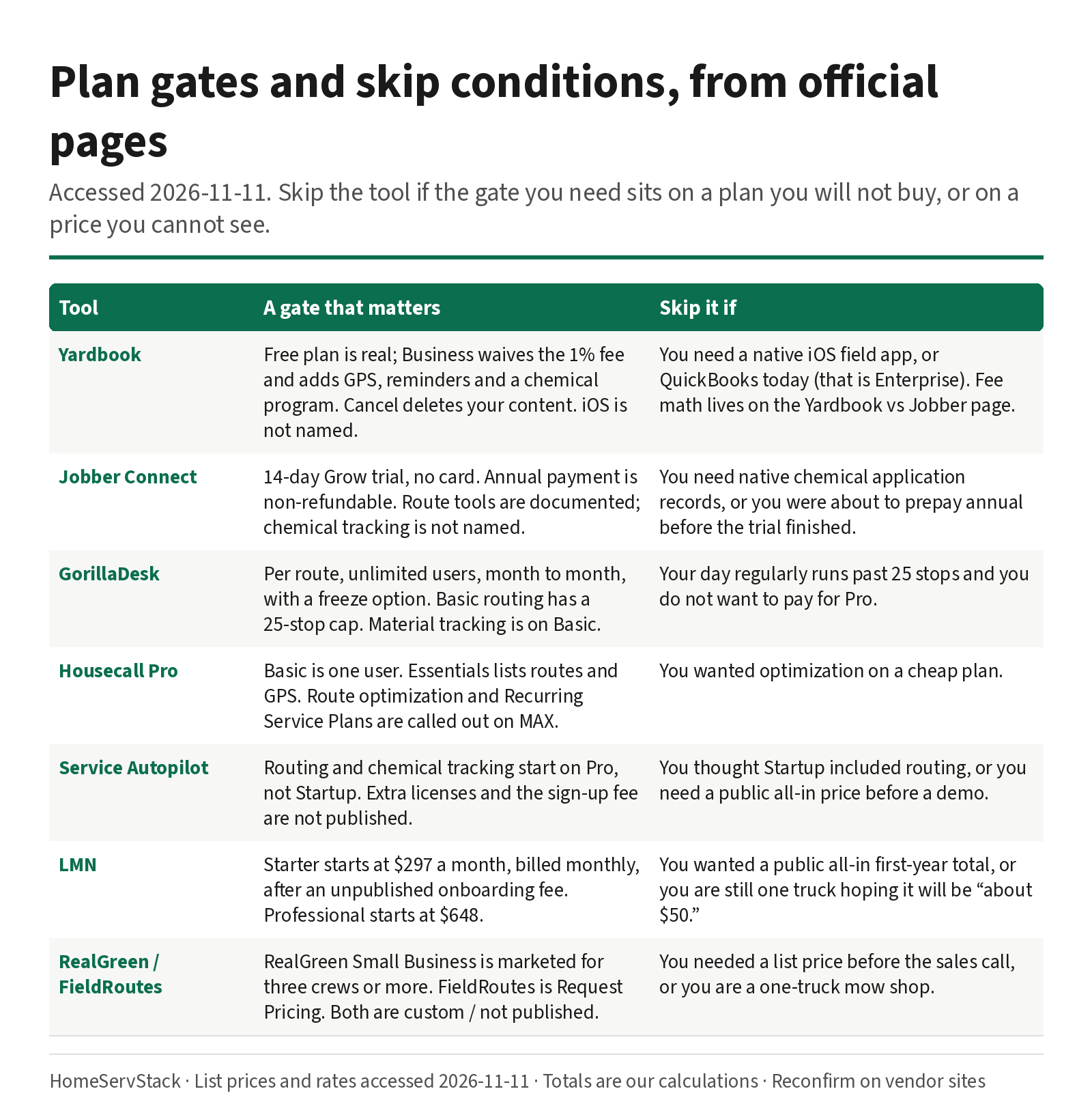
Yardbook. The free plan is a real start: customers, schedules, invoices, routing and card payments, with web, desktop and Android access listed on every plan. Business, at the published annual-plan rate, waives the 1% fee and adds GPS, automatic invoice reminders and the multi-step chemical program. Enterprise adds QuickBooks and drops the ads. iOS is not named on the pricing page. Cancellation deletes your content, per the terms — export before you leave. The fee math, the app reports, and the Jobber comparison are in Yardbook vs Jobber. Skip the free plan as a long-term home once that fee math, or the app, is the Tuesday pain. Skip Yardbook if you need a native iOS field app or a quote-to-cash generalist.
Jobber. Budget Connect. The lawn page describes recurring visits, weather rescheduling and a mobile app. Routing, reminders and automatic payments are Connect features. The annual payment is non-refundable. u/Agreeable-Ad6520, a landscaping operator, wrote: “We have grown from 3 to 40 employees on the platform.” (comment, 2025-12-19). That is a growth report, not a promise it will feel cheap at 40 logins. Skip Jobber if native chemical tracking is why you came. Skip Core if routing, reminders or autopay are the point.
GorillaDesk. Per-route, unlimited users, month to month, 14-day trial, no setup fee. Material tracking is listed on Basic, which matters for a small treatment shop that does not want a custom quote. Basic routing’s 25-stop cap is the gate to test on your real Thursday. Extra-route prices are published. Skip GorillaDesk Basic if your optimization needs regularly exceed that cap and you are not willing to pay for Pro. Skip it if you wanted a per-user generalist with a long public help library for quotes; this is a route product.
Housecall Pro. Published prices, including Basic, Essentials and MAX, on annual and monthly billing. For lawn, Essentials is the routes-and-GPS plan; MAX is the optimization and Recurring Service Plans plan. A MAX trial will show you features you may not keep. Skip Basic for a five-person crew; it is one user. Skip MAX if you only needed the mid-plan routes. The five-user mid-plan sticker matches Jobber Connect; the 6-to-15-user curve for a cleaning-shaped roster is worked in Jobber vs Housecall Pro, and the same published extras apply if your lawn roster grows that way.
Service Autopilot. This is a green-industry system, and the published card is only part of the bill. Startup, Pro and Pro Plus are annual rates, each plus a sign-up fee whose amount is not published. Elite is contact for pricing. License bundles are 1 business user plus 1, 2, 5 or 8 mobile licenses. Extra licenses, QuickBooks on Pro and Pro Plus, and two-way texting are call-for-pricing. Route optimization and chemical tracking start on Pro, not Startup.
A 10-year user is leaving. u/CriscoCamping, a snow and lawn operator, wrote: “Jobs randomly dissappear and and you might go two or three weeks missing a lawn” (comment, 2025-10-14). In the same thread: “It didn’t used to, I’ve been using it for 10 years, but it was cheaper and much simpler.” They also stated a bill “with all our users it is $500/mo.” — that is their claim, not a list price; Pro Plus publishes $499 before the sign-up fee and extra licenses. Another commenter, u/woodljd, defended it: “Jobber sucks compared to service autopilot you just didn’t know how to use it but good down grade.” (comment, 2025-02-24). Skip Startup if routing or chemical tracking is why you came. Skip Service Autopilot if you need a public all-in price, including the sign-up fee and extra licenses, before a demo. A longer alternatives page is a later spoke; the short Jobber-versus-Yardbook note is on that pairwise page.
LMN. Starter starts at $297 a month, billed monthly, after a one-time onboarding fee that is not published, for 1 office or crew-lead license and 5 crew licenses. Professional starts at $648, with 3 and 15. Additional licenses are “available for a fee.” The product is a budget, an estimate, and a crew app, which is the right shape for a maintenance company that also bids installs. Skip LMN as a first purchase for a one-truck mow route. The published starting price, plus an unknown onboarding fee, is a different category.
RealGreen and FieldRoutes. RealGreen, now under WorkWave, offers a custom quote. Small Business is “ideal for 3 crews or more” and lists a full CRM, dynamic routing, a mobile app and a customer portal. FieldRoutes, a ServiceTitan company, offers Growth and Corporate packages behind Request Pricing, and names route optimization on the Corporate card. u/kyle_lynn06 wrote: “I didn’t see a future with yardbook and real green wouldn’t even give me a demo they just said I’m too small right now to use their software.” (comment, 2025-03-14). Skip both as a one-truck starting point. Get a demo when treatment programs at volume are the business.
Ways this decision goes wrong
- Shopping only for routing. Treatment records, rain-week billing and the meter you pay on will decide the year.
- Buying Service Autopilot Startup for route optimization. It is not on that plan.
- Treating Yardbook’s free plan as free at any card volume. Run the 1% math on the pairwise page.
- Prepaying Jobber annually after a Grow trial without testing Connect’s gates. The charge is non-refundable.
- Taking a RealGreen or FieldRoutes demo as a one-truck plan. One is marketed at three crews or more; the other does not publish a price.
- Inventing an LMN first-year total, or a Service Autopilot sign-up fee. Those amounts are not published. Leave the cell blank.
- Ignoring a 25-stop routing cap, or a license bundle that covers two phones when you have five people in the field.
What to do this week
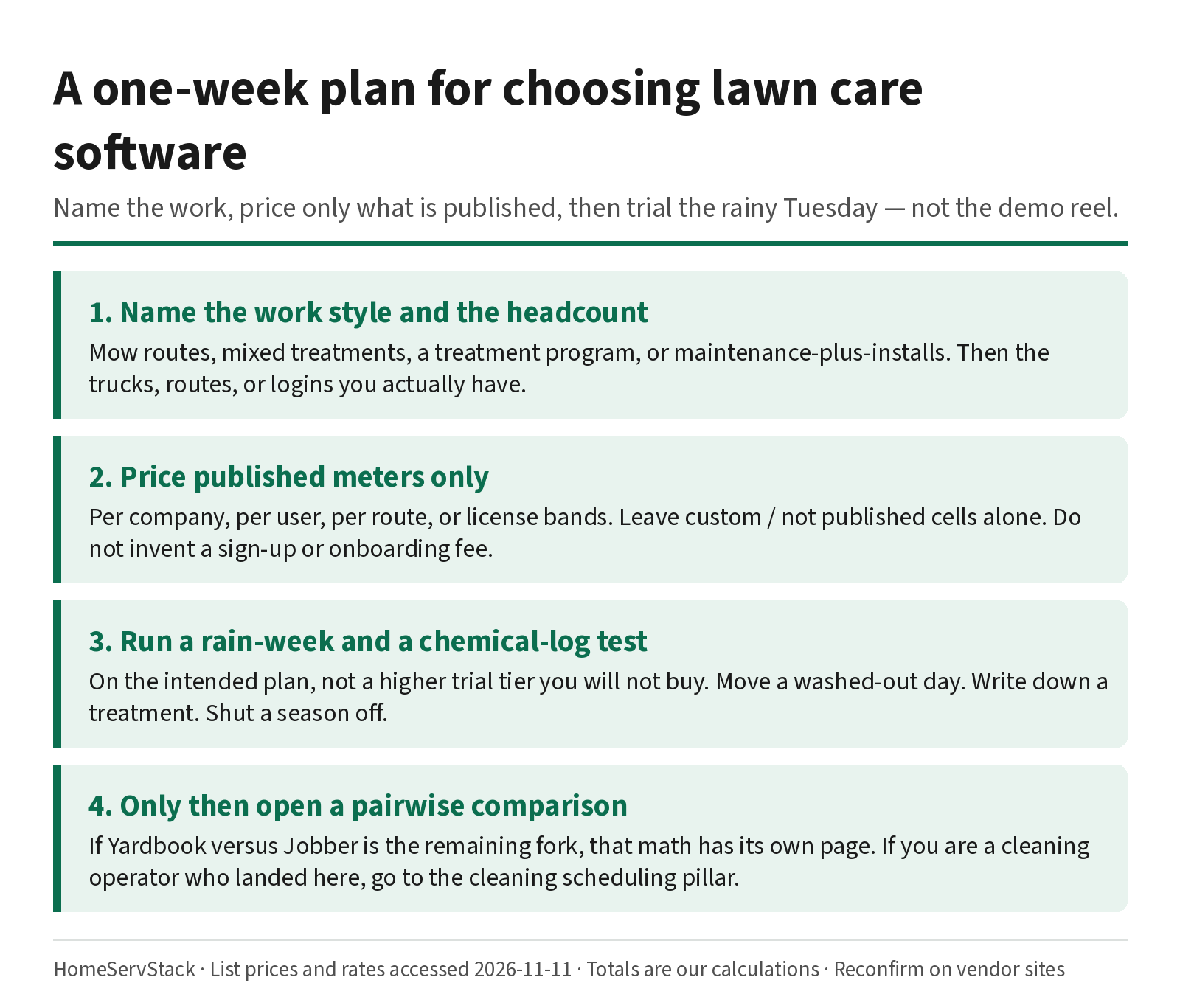
- Write down your work style (mow, mixed, treatment, maintenance-plus-installs) and your real headcount or route count.
- Price only published plans, at that count, on the meter the vendor actually uses. Leave unpublished cells blank.
- Run the rain-week and, if you treat lawns, the chemical-log test on the plan you will buy, not on the top-shelf demo.
- If Yardbook versus Jobber is the remaining fork, continue in Yardbook vs Jobber. If you are a cleaning operator who landed here by accident, go to the scheduling pillar.
How we researched this
On 2026-11-11 we re-fetched official pricing for Yardbook, Jobber, Service Autopilot, GorillaDesk, Housecall Pro, LMN, RealGreen and FieldRoutes, plus Yardbook’s terms, Jobber’s lawn, Connect and subscribe pages, and the BLS May 2025 OEWS table and NALP industry-statistics page. Every subscription figure is a published list price or a HomeServStack calculation from those prices, labeled as such. Where a vendor does not publish a number — RealGreen, FieldRoutes, the Service Autopilot sign-up fee and extra licenses, the LMN onboarding fee, Yardbook month-to-month rates — the cell is custom / not published. We also read public owner comments from Reddit, accessed the same day via the Arctic Shift archive. Quotes are verbatim, with handles only. User-stated prices are their claims, not our list prices.
We did not run paid production accounts for this article. We have no affiliate relationships with any vendor named here. We do not crown a single winner; we segment by work style and size.
Glossary
- Meter. How the vendor charges: per company, per user band, per route, or by license bundle.
- Route. In GorillaDesk, a schedule — often one technician’s day, or a crew that rides together. Extra routes have published add-on prices.
- License band. Service Autopilot’s people model: a set number of business (office) users and mobile licenses. Extras are not published.
- Sign-up fee. On Service Autopilot, an amount added to every paid plan and not published on the pricing page.
- Onboarding fee. On LMN, a one-time charge whose amount is not published, and which the starting monthly prices come after.
- Chemical tracking / material tracking. The application record for fertilizer and weed-control work. Named on GorillaDesk, on Service Autopilot Pro and above, and on Yardbook Business as a multi-step chemical program. Not named on Jobber’s official lawn or pricing pages we fetched.
- Billed annually. A monthly-equivalent price that assumes you prepay the year. Yardbook’s paid cards are labeled this way; Jobber and Housecall Pro publish both annual and monthly.
- Custom / not published. We will not invent a list price. Get a quote, or leave the cell blank.
Corrections and updates
- 2026-11-11: Re-scoped from a routing-and-recurring angle to a “best lawn care software” pillar. The slug changed from the retired
best-lawn-care-software-routing-recurringtobest-lawn-care-software(the old path is no longer a live URL). Added GorillaDesk and Housecall Pro with published prices, LMN’s starting monthly prices, and FieldRoutes as a request-pricing option. The Yardbook 1% fee math now lives in Yardbook vs Jobber. Added BLS May 2025 wage medians and NALP industry figures, plus sourced owner comments on Service Autopilot, Jobber growth and Jobber’s chemical-tracking gap. Prices re-checked 2026-11-11. - 2026-11-10: First published as a routing and recurring-billing lawn guide. Superseded by the rewrite above.
Related guides
- Yardbook vs Jobber — the 1% fee versus Business at the published annual-plan rate, the app gap, and when Connect is the next step.
- Best scheduling software for cleaning businesses — the cleaning-side pillar, if that is actually your trade.
- Jobber vs Housecall Pro for cleaning — the mid-plan published-price fork, useful if your lawn roster is growing along the same user bands.
Frequently asked questions
What is the best lawn care software?
For a one-truck mow route, start with Yardbook's free plan and read the fee math before you stay on it. For a growing mow or mixed home-service shop, start with Jobber Connect. For treatments and chemical records as the product, look at GorillaDesk, Service Autopilot Pro, or a RealGreen-class demo. Pick by mow routes versus treatment programs, and by the meter you pay on, not by a generic 'best' list.
How much does lawn care software cost?
Published starting points, accessed 2026-11-11: Yardbook is free, then $34.99 and $49.99 a month on annual plans. Jobber Connect is $99 a month billed annually for one user, or $149 for five. GorillaDesk is $49, $99 or $149 a month for the first route. Housecall Pro Basic is $59 annually ($79 monthly) for one user; Essentials is $149 ($189) for five; MAX is $299 ($329) for eight. Service Autopilot is $49, $199 or $499 at annual rates, each plus an unpublished sign-up fee. LMN Starter starts at $297 a month after an unpublished onboarding fee. RealGreen and FieldRoutes do not publish list prices.
Does Jobber do route optimization and chemical tracking?
Jobber's lawn-care page describes recurring visits, rescheduling after weather delays, and route tools. Routing is named as a Connect-plan feature in Jobber's help. Native chemical or fertilizer application tracking is not named on the official lawn or pricing pages we fetched on 2026-11-11. Treatment-heavy shops should compare GorillaDesk, Service Autopilot Pro, or a RealGreen-class tool.
Is Yardbook really free?
The Starter plan is free, and it includes customers, scheduling, invoices, routing and card payments. Yardbook's terms add a 1% Yardbook processing fee on non-premium and trial online payments, on top of Stripe. Business at $34.99 a month, on an annual plan, waives that fee and adds GPS, automatic invoice reminders and a multi-step chemical program. The fee-versus-subscription math, and when to leave for Jobber, is in our Yardbook vs Jobber guide. Month-to-month Yardbook rates are not published.
When should a lawn company look at Service Autopilot or RealGreen?
Look at Service Autopilot when route optimization and chemical tracking are Tuesday problems, and budget Pro at $199 a month billed annually, plus a sign-up fee whose amount is not published. Startup at $49 does not include those two. Look at RealGreen-class tools when treatment programs and dynamic routing are the business and you have multiple crews; RealGreen markets Small Business for three crews or more, and list prices are custom / not published. A one-truck mow shop should not start there.
Does GorillaDesk charge per user?
No. GorillaDesk is priced per route, not per user, with unlimited users on every plan. Basic is $49 a month for the first route, Pro $99, Growth $149, all month to month. Extra routes have published add-on rates on the pricing FAQ. Basic routing is capped at 25 stops; material tracking for chemical use records is listed on Basic. You can freeze a monthly account in the off-season, per the same FAQ.
Sources
- Yardbook Pricing — Accessed
- Yardbook Privacy Policy and Terms — Accessed
- Jobber Pricing — Accessed
- Jobber: Lawn Care Software — Accessed
- Jobber Help: The Connect Plan — Accessed
- Jobber Help: How to Subscribe — Accessed
- Service Autopilot Pricing — Accessed
- GorillaDesk Pricing — Accessed
- Housecall Pro Pricing — Accessed
- LMN Pricing (Granum) — Accessed
- RealGreen Pricing and Modules — Accessed
- FieldRoutes Pricing — Accessed
- BLS OEWS Table 1, National employment and wage data by occupation, May 2025 — Accessed
- NALP: Landscape Industry Statistics — Accessed
- Reddit r/Snowplow: going from 1 truck to a small fleet (u/CriscoCamping) — Accessed
- Reddit r/landscaping: Is Jobber worth it for small teams (u/Agreeable-Ad6520, u/spdsuk) — Accessed
- Reddit r/LawnCarePros: Yardbook vs Jobber (u/kyle_lynn06) — Accessed
- Reddit r/landscaping: CRM help for growing business (u/woodljd) — Accessed
Was this helpful?
One tap, no account, no personal data. We only keep a yes or no, counted with the other votes on this page.
Keep reading
More in Lawn Care Software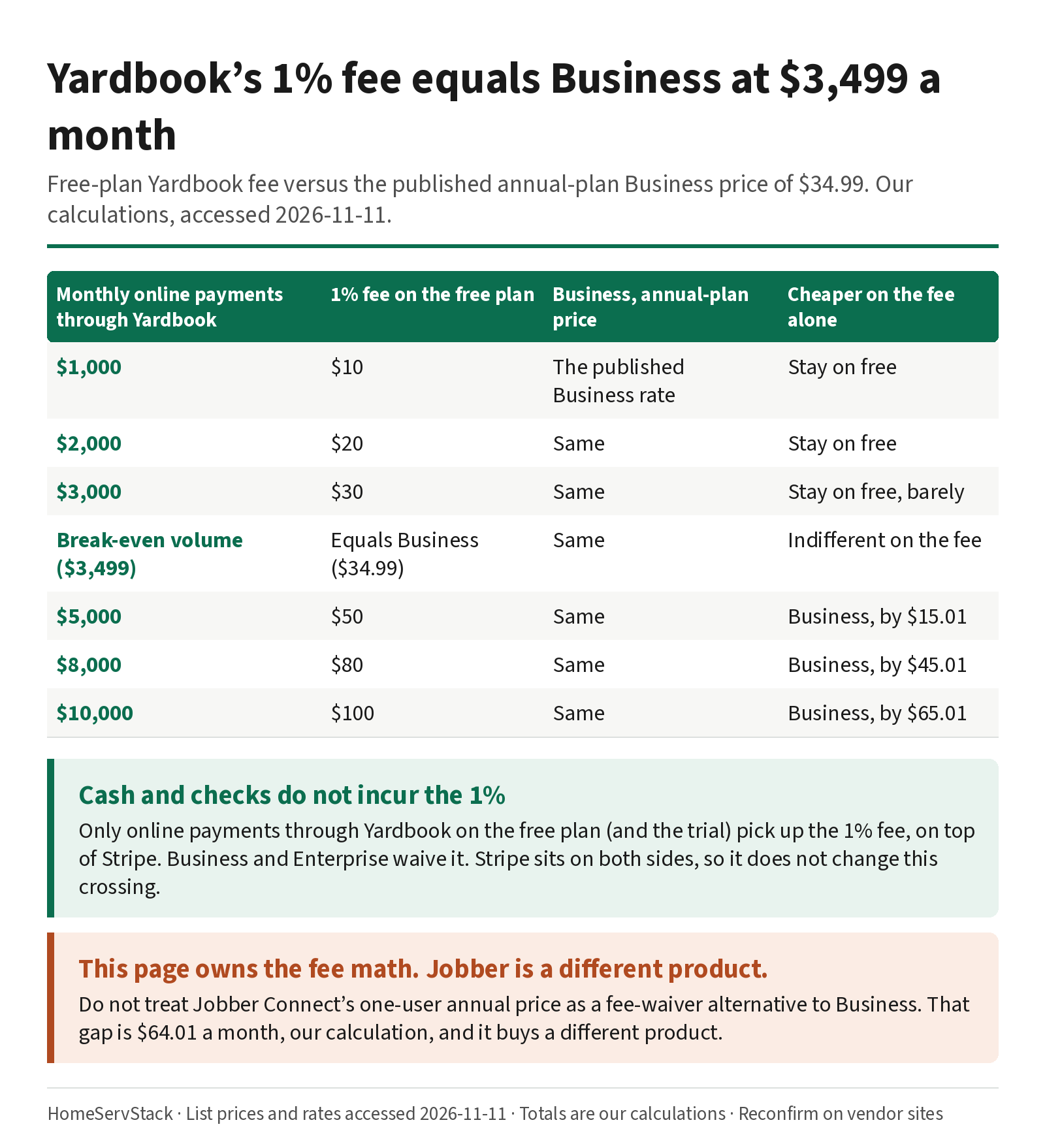
Yardbook vs Jobber: The 1% Fee, the $34.99 Crossover, and When to Leave
Yardbook's free plan adds a 1% fee that crosses Business at $34.99 near $3,499 a month in online payments. When Jobber Connect is the next step.
Free Cleaning Business Software: What Each $0 Plan Actually Allows
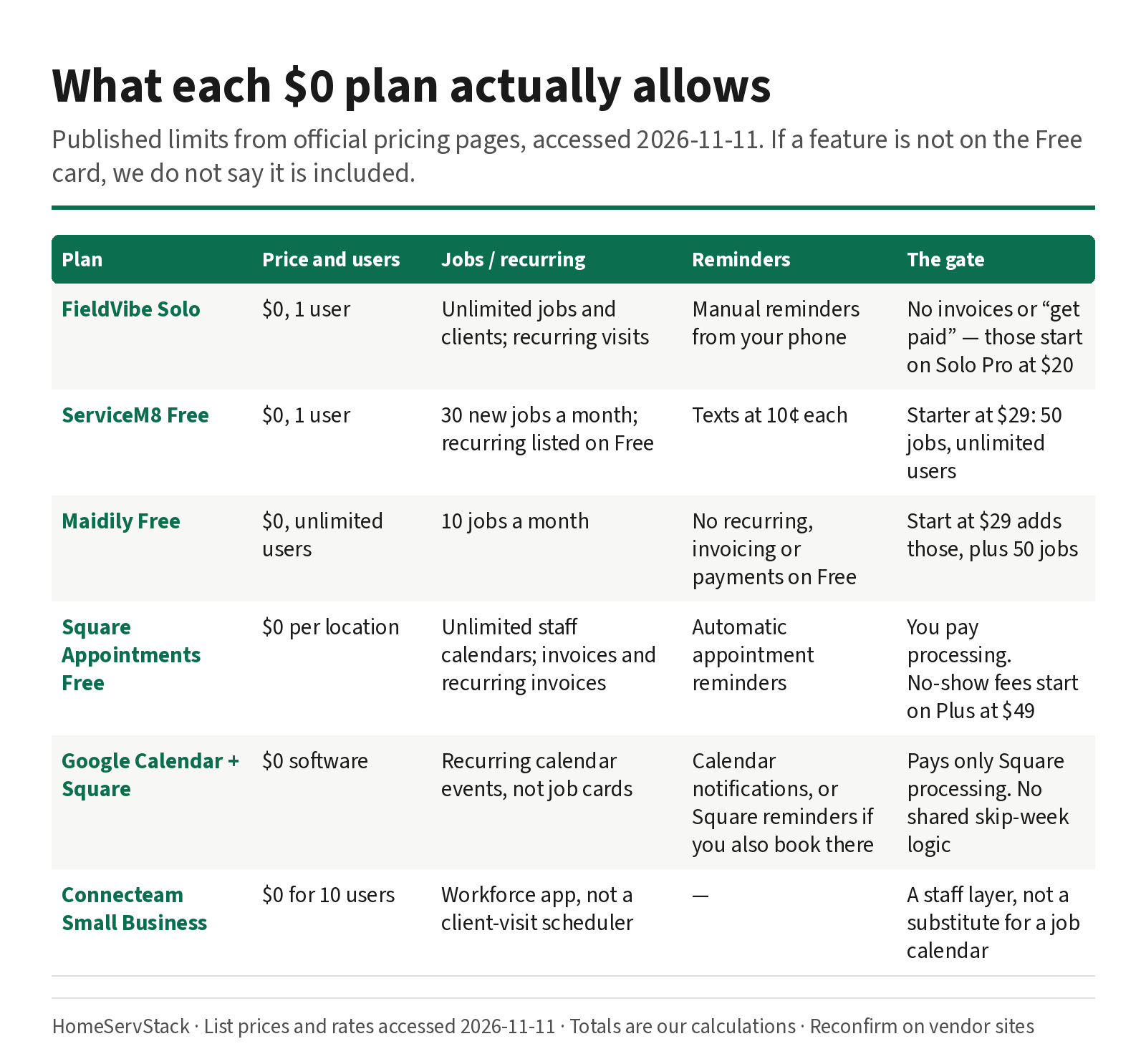
What free cleaning business software actually allows — FieldVibe, ServiceM8, Square, Maidily — and the limits that tell you it's time to pay.
Cleaning Business Autopay: Card-on-File Rates, Declines, and Skip-Week Billing
Autopay and card-on-file rates for cleaning businesses, plus what Jobber, Housecall Pro and ZenMaid do when a card declines or a week is skipped.
Comments
Share a correction or an operator experience. Comments are plain text, held for review, and appear only after they are approved. A lasting email is required and is never shown. We may send a confirmation link once mail is configured.
No approved comments yet.