Watch a short briefing
Prices checked 2026-11-11. HomeServStack has no affiliate deals with any vendor named here. Totals below are our calculations from published list prices and from Yardbook’s published 1% fee; they are not vendor quotes. We did not run paid accounts for this article (method).
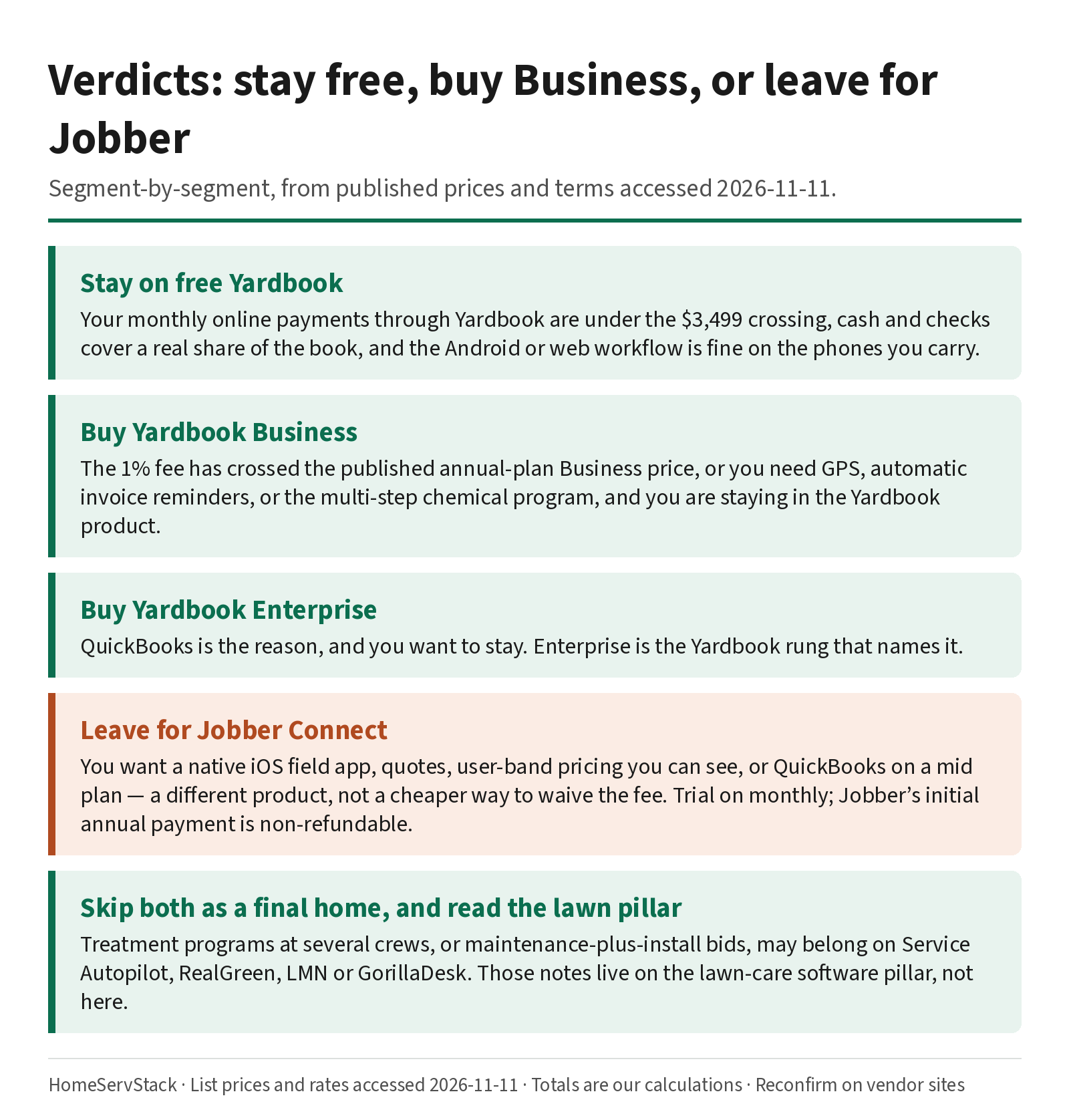
Short answer: Stay on free Yardbook while the 1% online-payment fee is smaller than Business, and you can live with the app and the ads. The fee equals that subscription at $3,499 a month of online payments, our calculation from the published rate and the published annual-plan price. Move to Jobber Connect when you need a native field app, published user bands, and a quote-to-cash workflow the free plan was never meant to be.
The 1% does not appear on Yardbook’s pricing card. The card says “Yardbook Processing Fee Waived” under Business, which is a polite way of telling you the free plan is paying a fee. The number lives in the terms: “The Yardbook processing fee for non-premium accounts is 1% of each transaction. This fee also applies to any free trial accounts.” It sits on top of Stripe, and it is waived on Business and Enterprise.
A lawn operator already ran the shape of this math. u/The_Realtree, going into year six, wrote: “Yardbook takes $0.00 as a subscriber, so once the processing fees outweigh the subscriber rate, that’s a good time to go ahead and subscribe, as you then start to save money.” (comment, 2025-03-09). He is right about the shape. This page owns the published-number version of it.
So here is the argument. Leave free Yardbook when that 1% fee crosses the Business subscription — the break-even sits in the takeaways, and the worksheet is below — or when the app, the ads, or QuickBooks are the Tuesday problem. Move to Jobber Connect when you are buying a different product — routing, reminders, autopay and a native mobile app on published user bands — not when you only needed the fee waived.
The category map — mow routes versus treatment programs, GorillaDesk, Service Autopilot, RealGreen — lives in best lawn care software. This page is the pairwise fork. Cleaning operators who landed here by accident want the scheduling pillar.
The 1% is the real price of free, and the crossover is a worksheet, not a vibe
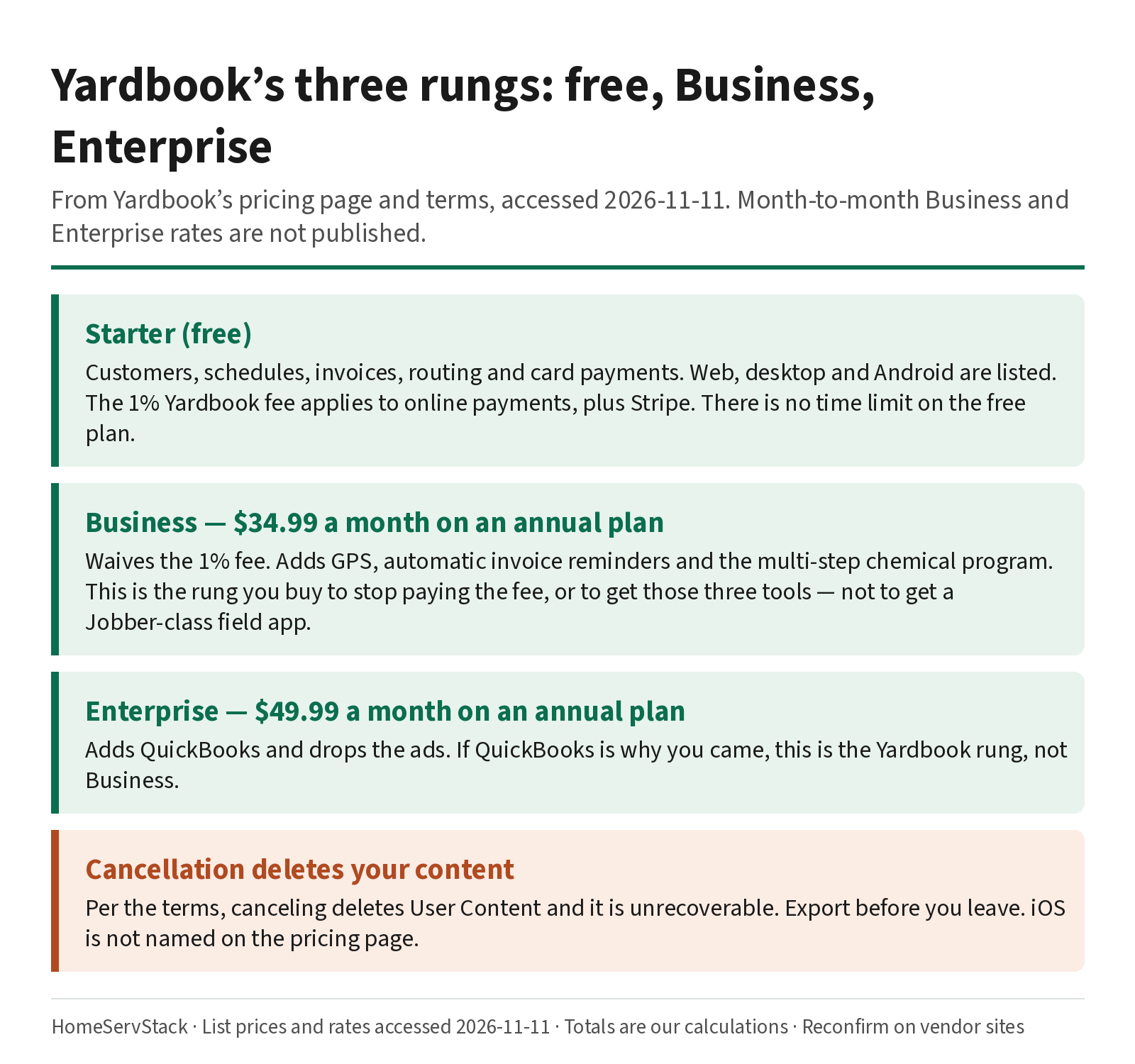
Yardbook’s pricing page lists three plans. Starter is free: customer management, jobs and scheduling, estimates, invoices, routing, expenses, reports, lot measurement, employee access, credit card payments, snow removal and a product catalog. Business adds bulk email, Twilio texting, GPS, automatic backup, automatic invoice reminders, a multi-step chemical program, customized lead capture, and the waived fee. Enterprise adds QuickBooks sync, a branded company portal, and no ads. A footnote says the paid prices are for annual plans, and that different rates apply to month-to-month. Those month-to-month rates are not published. We will not invent them.
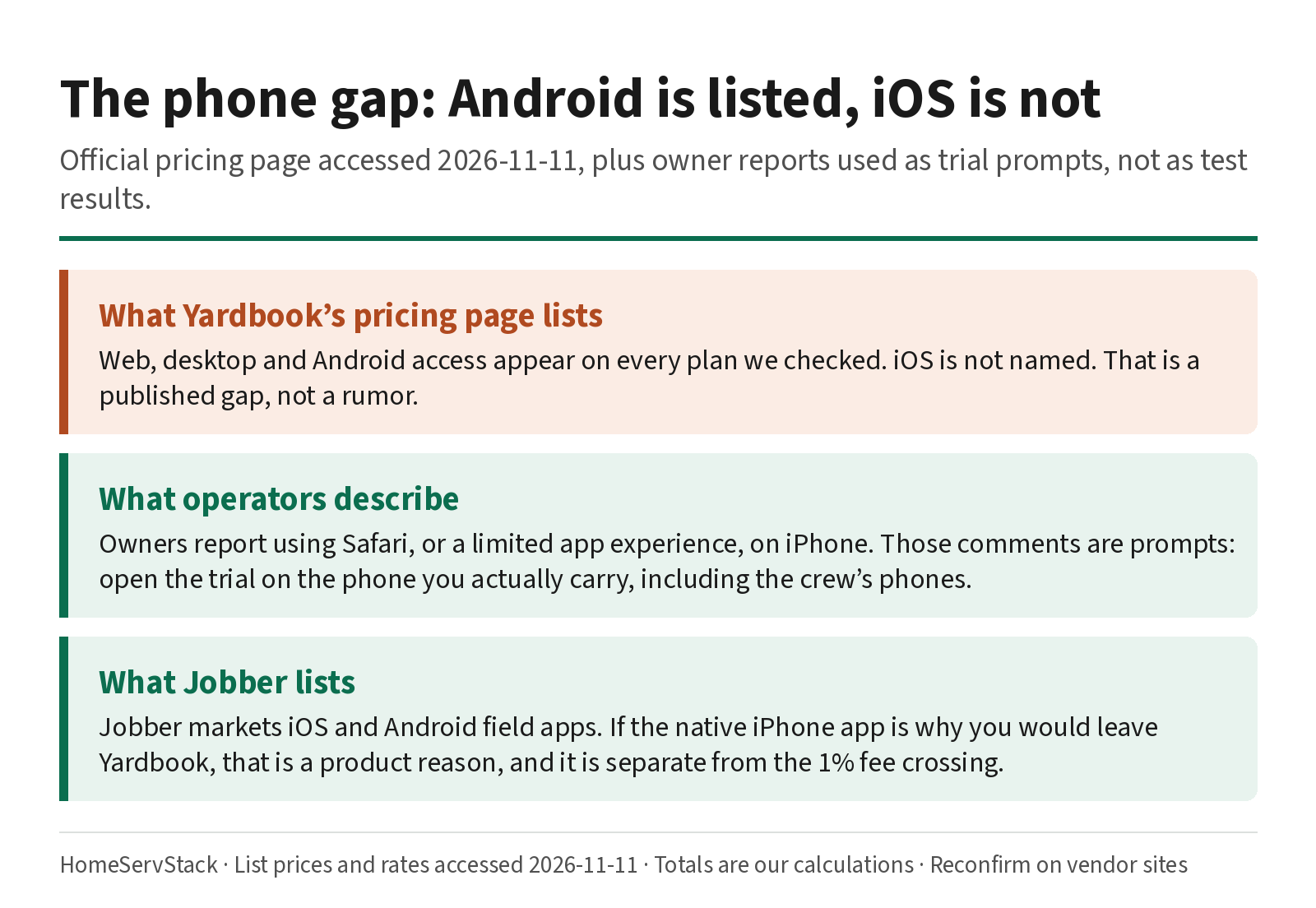
All plans list web, desktop and Android mobile app access. iOS is not named.
The fee is the part most listicles wave at. It is a Yardbook charge, deducted from each online payment, in addition to Stripe’s processing. Stripe’s standard US online card rate, on the official pricing page we re-fetched, is 2.9% + 30¢. That Stripe rate applies on the free plan and on Business. It does not change the 1%-versus-subscription comparison, because you pay Stripe either way. What changes is Yardbook’s own 1%.
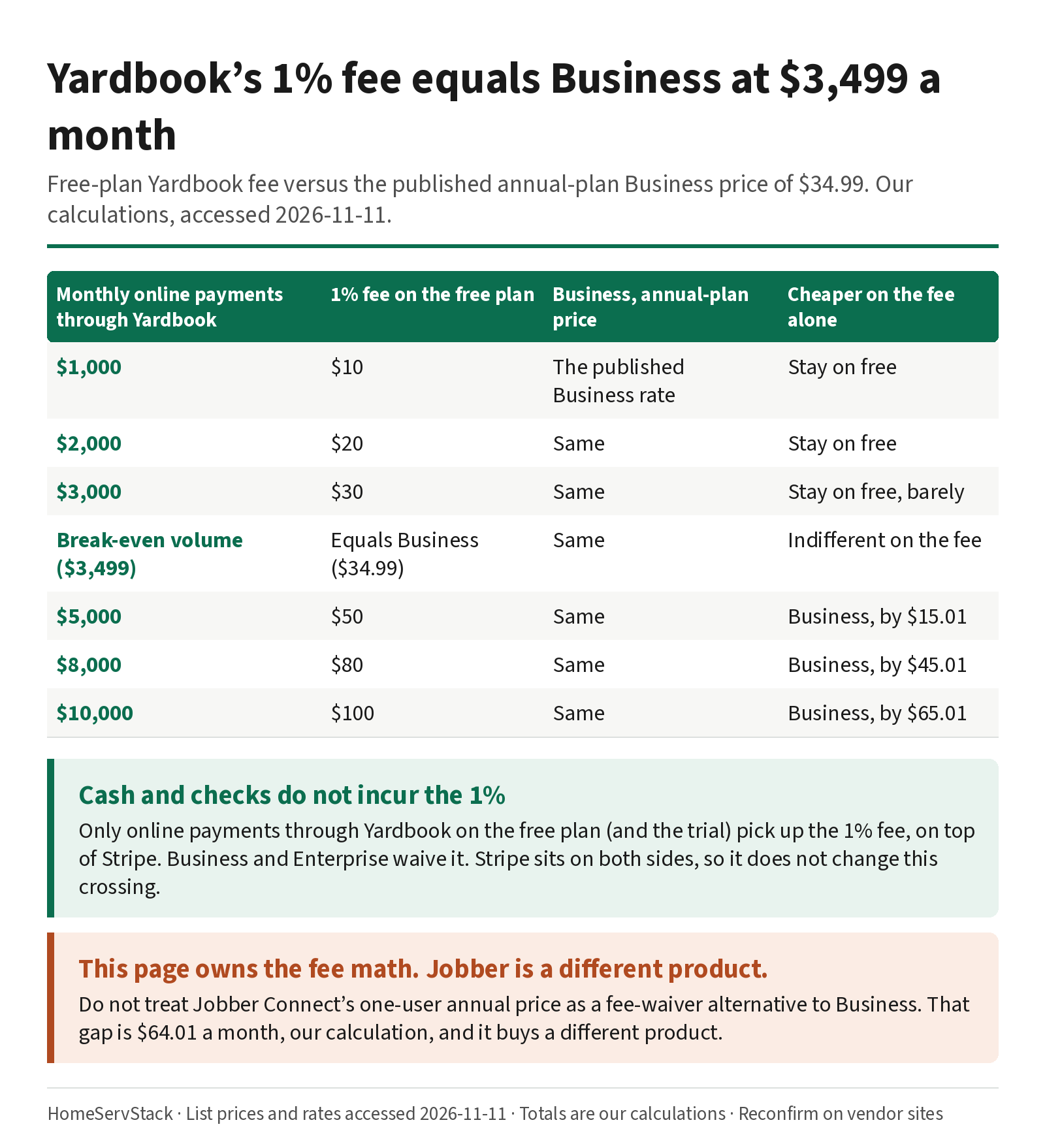
Assumptions for the worksheet. The 1% comes from Yardbook’s terms, accessed 2026-11-11. The Business price is the published annual-plan monthly figure. Online payments means payments taken through Yardbook, not cash, checks or a card you run on a separate Square reader. Totals are HomeServStack calculations.
| Monthly online payments through Yardbook | 1% Yardbook fee, free plan | Business, annual-plan price | Cheaper on the fee alone |
|---|---|---|---|
| $1,000 | $10 | The published Business rate | Stay on free |
| $2,000 | $20 | Same | Stay on free |
| $3,000 | $30 | Same | Stay on free, barely |
| Break-even volume | Equals Business | Same | Indifferent on the fee |
| $5,000 | $50 | Same | Business, by $15.01 |
| $8,000 | $80 | Same | Business, by $45.01 |
| $10,000 | $100 | Same | Business, by $65.01 |
What this means: at $2,000 of online payments, the fee is still cheaper than the subscription, if you can live with ads and the app. At $5,000, you are paying $15.01 a month for the privilege of not subscribing, and you are also going without the Business features. Use your actual online volume, not your total revenue. A shop that invoices $8,000 a month and collects most of it by check is not at the $8,000 row.
The same operator who described the trigger also described the timeline. u/The_Realtree wrote: “I was using the free version up until my third season, then I added a subscription to reduce processing fees. I’m going into year 6 and it’s worth every penny so far.” (comment, 2025-03-09). Free can last years. u/def_john, a solo mowing operator in a Chicagoland suburb, wrote: “I’ve personally used the free version of Yardbook for my one-man mowing operation in a Chicagoland suburb. Going on my 5th season now. I currently have 36 biweekly or weekly mowing clients.” (comment, 2026-05-18). In the same comment: “I have nothing bad to say about Yardbook, honestly!” Thirty-six weekly or biweekly clients, fifth season, still on free. That is possible when the online-payment volume has not crossed the line, or when most of the book pays some other way.
The Bureau of Labor Statistics May 2025 median for landscaping and groundskeeping workers is $18.82 an hour. NALP’s industry page, accessed the same day, puts 2025 landscape-services market size at $188.8 billion and says labor costs are expected to rise roughly 20% by the end of 2029. Those figures are the stake for the other half of this decision — the app, the route, the rain week — not a reason to upgrade at $1,000 of card volume. A fee of $10 a month is not the labor problem. A route you cannot run from a phone can be.
Business and Enterprise buy more than a waived fee, and leaving deletes the file
If you subscribe, know what the next two rungs actually are.
Business is the first paid card. Besides the waived fee, the official list is bulk email, Twilio texting (Twilio’s own usage charges are separate, and we did not invent a rate), GPS tracking, automatic backup, automatic invoice reminders, a multi-step chemical program and customized lead capture. For a shop whose Tuesday pain is “I forgot to remind them” or “I need a chemical program,” this is the plan, whether or not the fee has crossed. For a shop that only wanted the 1% gone, it is still the plan, because there is no cheaper paid rung.
Enterprise is a different reason. QuickBooks sync, a branded portal, and no ads. u/spdsuk, a landscaping owner, wrote: “Really the only reason why I upgraded to their high tier option was so it would all export to quick books” (comment, 2025-11-05). If QuickBooks is why you are leaving free, price this rung, not Business, and compare it with Jobber Connect, which lists QuickBooks Online on Connect and above.
The exit cost is sharper than the entry. Yardbook’s terms say: “Upon processing your cancellation, all of your User Content will be deleted from the Services. This information cannot be recovered once your account is cancelled.” Export a client and job list before you cancel, including if you are only canceling a premium trial. u/spdsuk also described support, from when they used it, as “some of the best and most responsive customer service I have ever dealt with. Might be different now but when I was using it, it was strictly email based” (comment, 2025-11-06). Email-only and fast is still email-only; test a real question in week one if support is a deciding factor. Paid subscriptions, per the terms, cannot be terminated before the end of a period already paid, and fees already paid are not refunded except as the terms expressly allow.
The phone is the gap operators actually name
This is the most consistent owner complaint, and it is the one the pricing page almost tells you, by listing Android and not iOS.
u/EzraGrenFrog, a former lawn-care owner, wrote: “Yardbook, does not have a great (or even a good) mobile app. It is run off Safari which is ok but Jobber’s mobile app is spot on.” (comment, 2025-03-11). u/Midnight-Workshop, a lawn operator who moved to another tool, wrote: “I was on Yardbook too. Main issues with them was due to their app being super limited compared to the web version.” (comment, 2025-12-10). Those are user reports, not our tests. They match the official card in one respect: Android is listed, iOS is not. If your crew carries iPhones, this is a day-one trial item, not a footnote.
Jobber publishes iOS and Android apps, and its lawn page leans on the field app. The 14-day trial is the place to log in as the crew, not as the owner, and to complete a visit, take a photo, and collect a payment if that is how you work. Do it in the driveway, not at the desk.
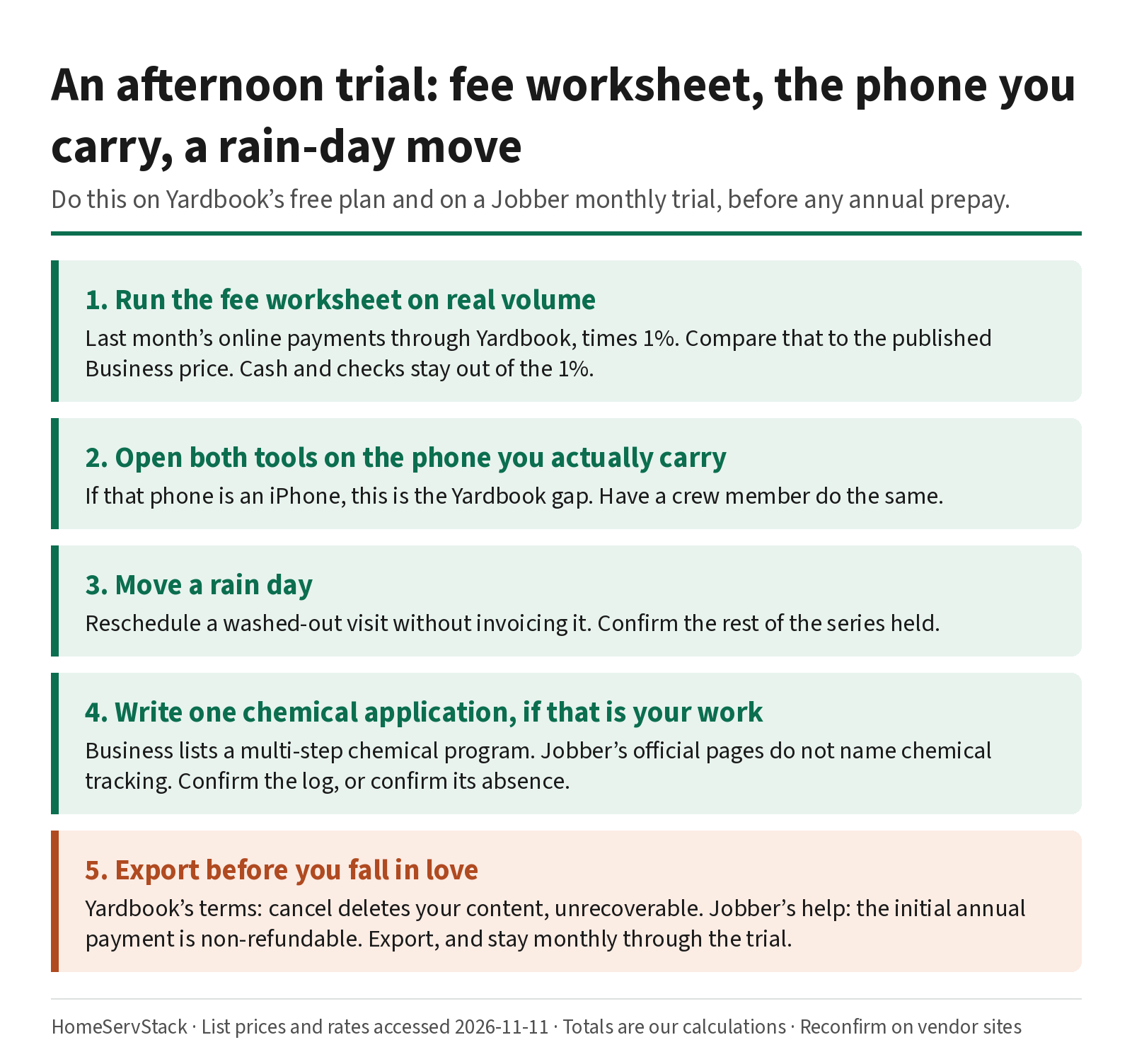
A labeled afternoon, steal this. Kim, one truck, runs the same weekly mow in both products, then:
- Opens the visit on the phone she actually carries. If it is an iPhone, Yardbook’s official card has already warned you.
- Moves Wednesday after a labeled rain, and checks that Thursday is intact and that the washout is not invoiced.
- Takes a payment the way most of her book actually pays. If it is an online card on free Yardbook, she writes down the 1% on that invoice, on top of Stripe.
- Exports a client list. She will want that file if she ever cancels.
Jobber’s rain-week and routing behavior, in the wider category, is in the lawn pillar. Here the test is narrower: can the phone, and the payment path, do Tuesday.
Jobber Connect is the other product, and the sticker is not a waived fee
If the fee worksheet says subscribe, Business is the first answer. Jobber is the answer when you want a general field-service platform: quotes, a client hub, a native app, published user bands, and, on Connect, routing, automated reminders and automatic payments.
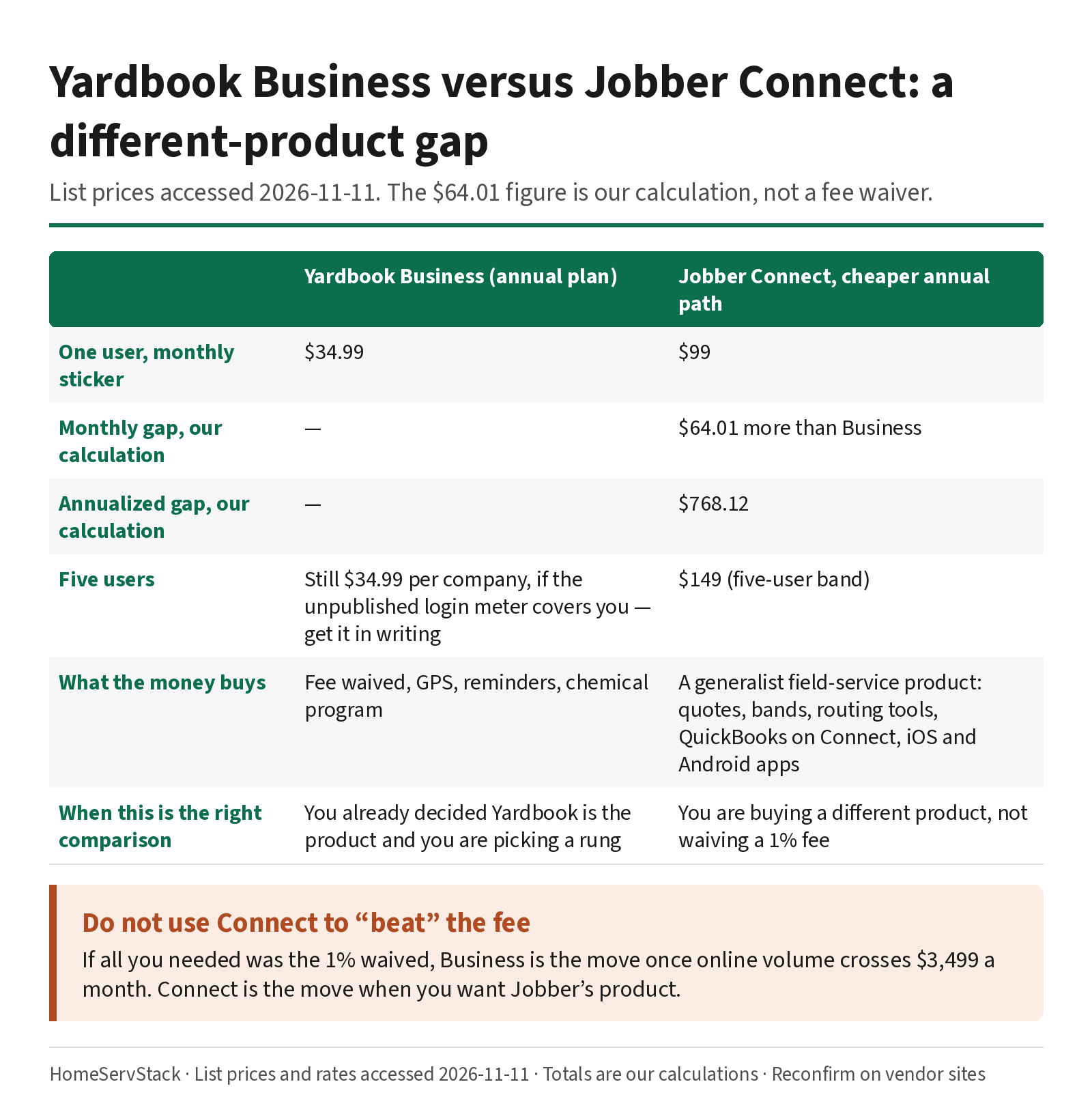
Published Connect prices, accessed 2026-11-11, billed annually: $99 for one user, $149 for five, $229 for ten, $299 for 15, plus $29 per extra user. The cheaper path at 12 users is the ten-user band plus two extras. Month-to-month is higher; the annual payment is non-refundable, per Jobber’s subscribe help. A Capterra reviewer, Chase C., Owner, dated 2026-11-10, put it: “test every integration you depend on before committing to an annual plan.” (Jobber reviews). If you prepay, you keep access to the end of the term when you cancel, and the money does not come back.
One-user comparison, our calculation. Business at the published annual-plan rate versus one-user Connect: the gap is $64.01 a month, or $768.12 a year. That is not a fee-waiver. That is a different product. If all you needed was the 1% gone, Business is the cheaper way to get it, and you also get GPS, reminders and the chemical program. If you needed Jobber’s app, quotes and Connect routing, the gap is the price of that product.
Five-user comparison. Connect’s five-user band versus Yardbook’s per-company card. Yardbook does not publish a per-login meter. We will not invent “unlimited users” as a verified count. Get the login rule in writing if four people will be in the field. The sticker gap looks large. The meter is why.
Chemical tracking is the Jobber caveat. It is not named on the official lawn or pricing pages we fetched. u/kyle_lynn06 hoped Jobber would add it; that comment, and the rest of the treatment-tool map, sit on the lawn pillar. If the chemical log is why you are leaving Yardbook, Business already lists a multi-step chemical program, and a green-industry tool may be the next call, not Connect.
A shorter note on Service Autopilot, then a verdict
This used to be a three-way page. It is not, anymore, because the question people actually type is Yardbook versus Jobber. Service Autopilot belongs in the conversation only as an alternative when routing and chemical tracking, in a green-industry system, are the job.
The published card, at annual rates, is Startup, Pro and Pro Plus, each plus a sign-up fee whose amount is not published. Route optimization and chemical tracking start on Pro, not Startup. License bundles are tight, and extras are not published. The fuller gates, and RealGreen, are on the lawn pillar.
One recent first-hand report is from a 10-year user who is leaving. u/CriscoCamping, a snow and lawn operator, wrote: “Jobs randomly dissappear and and you might go two or three weeks missing a lawn” (comment, 2025-10-14). In the same comment: “It didn’t used to, I’ve been using it for 10 years, but it was cheaper and much simpler.” That is a reason to demo carefully, not a reason to drag this page back into a three-name keyword fight.
Verdicts, and who should skip which tool
- One truck, online payments still small, Android is fine. Stay on free Yardbook. Re-run the worksheet when card volume jumps. Skip a paid plan if the 1% is still cheaper and you do not need Business features.
- The 1% has crossed, or you need reminders, GPS or a chemical program, and the app is acceptable. Yardbook Business, on an annual plan if you can live with that term. Ask for the unpublished month-to-month rate if you cannot. Skip Business if QuickBooks is the reason; that is Enterprise.
- The phone is the product, or you quote, or you want published user bands with Connect routing, reminders and autopay. Jobber Connect, at your real user count, after a month-to-month trial. Skip Jobber Core if those Connect gates are why you came. Skip a prepaid annual term until the rain-week, the phone, and any QuickBooks sample have passed.
- Skip Yardbook if the crew carries iPhones and the trial cannot live in the browser, or if you will not export before a cancellation.
- Skip Jobber if native chemical tracking is the reason, or if all you needed was the 1% waived.
- Skip treating this page as a Service Autopilot comparison. Use the pillar for that tool, and a future alternatives page.
Ways this decision goes wrong
- Staying on free because “it’s free,” past the point where the 1% is larger than Business. Run the worksheet with online volume, not total revenue.
- Inventing a month-to-month Business price. It is not published. Ask, or budget the annual-plan figure and know it might not apply.
- Buying Jobber to waive a 1% fee. Business does that, cheaper, and adds reminders and a chemical program. Buy Jobber for Jobber.
- Prepaying Jobber annually after a Grow demo without testing Connect. The charge is non-refundable.
- Canceling Yardbook without an export. The terms delete the content.
- Assuming an iPhone app because a competitor has one. The official Yardbook card lists Android.
- Turning this back into a three-way with Service Autopilot. Different job, different page.
A trial you can finish, then how we researched this
If you only have one afternoon: run the fee worksheet on last month’s online volume; open both products on the phone you carry; move a Wednesday and check the invoice; export a file from Yardbook; and, if Jobber is in the running, read the non-refundable annual line before you prepay.
On 2026-11-11 we re-fetched Yardbook’s pricing and terms, Jobber’s pricing, lawn, Connect, subscribe and cancel pages, Stripe’s published online rate, and the BLS and NALP figures used as stakes. The break-even is our calculation from the published 1% and the published Business price. We also read public owner comments from Reddit, via the Arctic Shift archive, and one Capterra review, accessed the same day. Quotes are verbatim, with handles only. User-stated prices are their claims, not our list prices.
We did not run paid production accounts. We did not invent a Yardbook month-to-month rate or a Service Autopilot sign-up fee. We have no affiliate relationships with any vendor named here. We segment; we do not crown a single winner.
Glossary
- Yardbook processing fee. A 1% charge on each online payment for non-premium and trial accounts, in addition to Stripe, waived on Business and Enterprise. From the terms, not from the pricing card.
- Online payments. Payments taken through Yardbook. Cash, checks and a card run outside Yardbook do not incur the 1%.
- Annual-plan price. Yardbook’s published Business and Enterprise figures are for annual plans. Month-to-month is acknowledged and not published.
- Break-even volume. The monthly online-payment total at which the 1% fee equals the published Business price. Our calculation, in the takeaways and the worksheet.
- Connect. Jobber’s mid plan, and the lawn plan to budget if you need routing, reminders and automatic payments.
- Content deletion. Yardbook’s stated result of cancellation: user content is deleted and cannot be recovered.
- Per-company card. Yardbook charges a plan price per company. The per-login meter is not published.
Corrections and updates
- 2026-11-11: Re-scoped from a three-way Jobber vs Service Autopilot vs Yardbook comparison to a pairwise Yardbook vs Jobber page, around the query “Yardbook vs Jobber.” The previous three-way slug was retired (it is no longer a live URL). The page now owns the 1% fee versus Business crossover and the published break-even volume, plus the app gap, the QuickBooks rung, and Jobber Connect as the next product. Service Autopilot is a short alternative note; tool-by-tool and RealGreen coverage live on the lawn pillar. Prices and terms re-checked 2026-11-11.
- 2026-11-10: First published as a three-way comparison. Superseded by the rewrite above.
Related guides
- Best lawn care software — the category map: mow routes versus treatment programs, meters, GorillaDesk, Service Autopilot and RealGreen.
- Best scheduling software for cleaning businesses — if cleaning, not lawn, is actually your trade.
- How much cleaning business software costs — Jobber’s band-versus-extras math on the cleaning side, if your roster is growing the same way.
Frequently asked questions
Is Yardbook or Jobber better for a lawn care business?
Yardbook's free plan fits a one-truck mow start if you can live with ads, a 1% Yardbook fee on online payments, and the listed Android app. Upgrade to Business, at the published annual-plan rate, when that 1% fee crosses the subscription, or when you need GPS, automatic invoice reminders or the multi-step chemical program. Jobber Connect fits a shop that wants a native mobile app, published user-band pricing, routing, reminders and autopay. Chemical tracking is not named on Jobber's official pages we fetched. Trial the app and a rain-week move before you prepay.
When does Yardbook's 1% fee cost more than the Business plan?
Yardbook's terms charge a 1% Yardbook processing fee on non-premium and trial online payments, on top of Stripe, and waive it on Business and Enterprise. Business is $34.99 a month on an annual plan. Our calculation: 1% of $3,499 in monthly online payments is $34.99, so that is the break-even. Below that, if you can live with the rest of the free plan, staying is cheaper on the fee alone. Cash and checks do not incur the 1%. Month-to-month Business rates are not published.
How much is Jobber compared with Yardbook Business?
From list prices accessed 2026-11-11, Yardbook Business is $34.99 a month for annual plans, per company. Jobber Connect is $99 a month billed annually for one user, or $149 for the five-user band, plus $29 per extra user. The gap at one user is $64.01 a month, or $768.12 a year, our calculation. That gap buys a different product, not a waived fee. Jobber's annual payment is non-refundable.
Does Yardbook have an iPhone app?
Yardbook's pricing page lists web, desktop and Android mobile app access on all plans. It does not name iOS. Operators have described running Yardbook in Safari, and have called the app limited compared with the web version. Jobber publishes iOS and Android apps. Test the phone you will actually carry, in the field, before you treat either product as a field tool.
Does Yardbook sync with QuickBooks?
QuickBooks sync is listed on Yardbook Enterprise, at $49.99 a month on an annual plan, not on Business. A landscaping owner, u/spdsuk, wrote that the high-tier option was the reason they upgraded, so the export would go to QuickBooks. Jobber lists QuickBooks Online sync on Connect and above. If QuickBooks is why you are leaving free Yardbook, price Enterprise against Connect, and test a sample sync or export in week one.
Should I consider Service Autopilot instead?
Only if route optimization and chemical tracking are Tuesday problems, and you can live with license bands plus an unpublished sign-up fee. Those features start on Pro, not on the $49 Startup plan. A 10-year user has described jobs disappearing from the schedule and is leaving. The fuller Service Autopilot and RealGreen notes live on the lawn-care software pillar. This page is the Yardbook-versus-Jobber fork, not a three-way keyword page.
Sources
- Yardbook Pricing — Accessed
- Yardbook Privacy Policy and Terms — Accessed
- Jobber Pricing — Accessed
- Jobber: Lawn Care Software — Accessed
- Jobber Help: The Connect Plan — Accessed
- Jobber Help: How to Subscribe — Accessed
- Jobber Help: Cancel Your Jobber Subscription — Accessed
- Stripe Pricing — Accessed
- BLS OEWS Table 1, National employment and wage data by occupation, May 2025 — Accessed
- NALP: Landscape Industry Statistics — Accessed
- Reddit r/LawnCarePros: Yardbook vs Jobber (u/The_Realtree, u/def_john, u/EzraGrenFrog, u/kyle_lynn06) — Accessed
- Reddit r/WhichCRM: Yardbook app limits (u/Midnight-Workshop) — Accessed
- Reddit r/landscaping: Yardbook QuickBooks and support (u/spdsuk) — Accessed
- Reddit r/Snowplow: leaving Service Autopilot after 10 years (u/CriscoCamping) — Accessed
- Capterra: Jobber reviews (Chase C., Owner, 2026-11-10) — Accessed
Was this helpful?
One tap, no account, no personal data. We only keep a yes or no, counted with the other votes on this page.
Keep reading
More in Lawn Care Software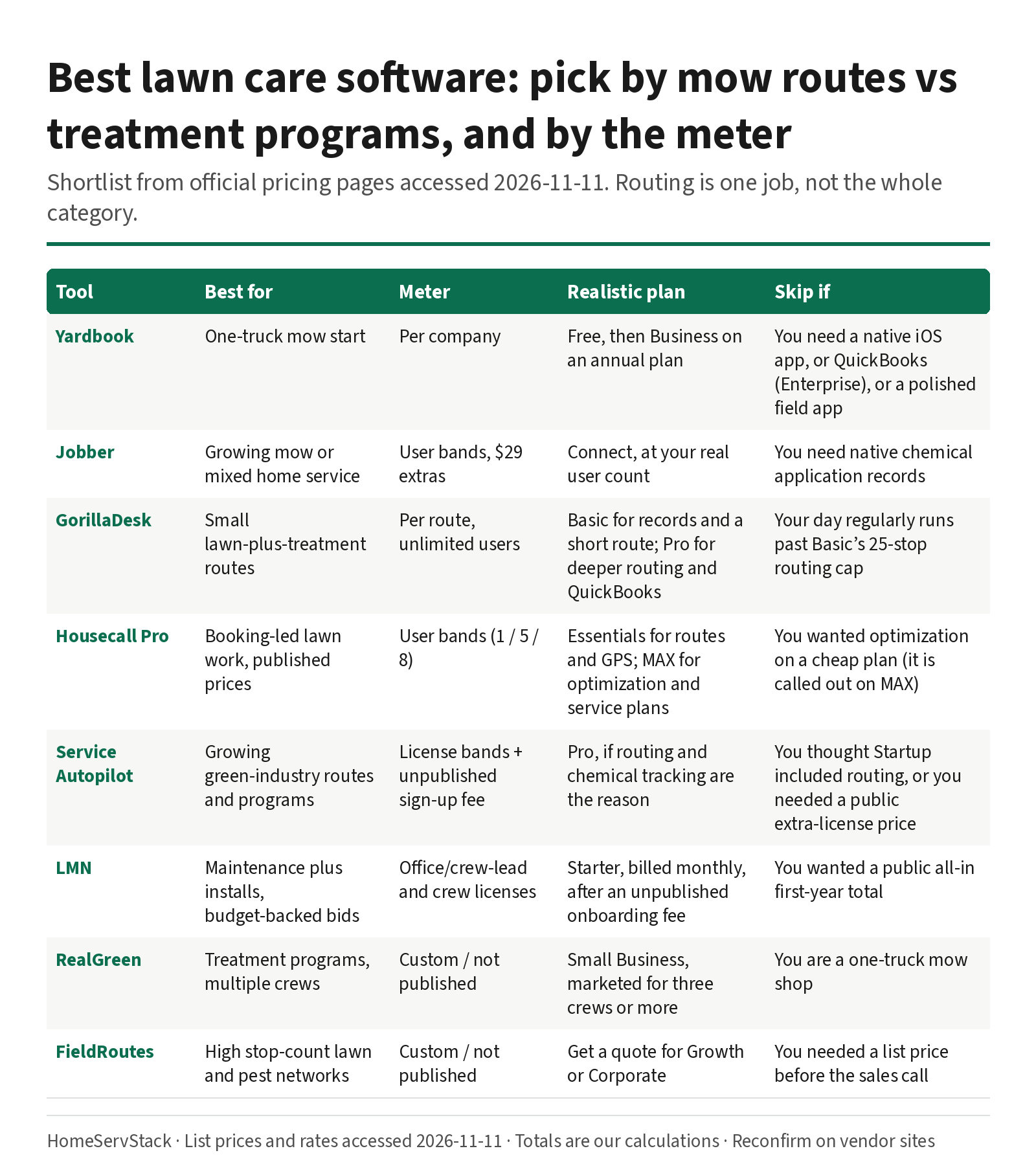
Best Lawn Care Software: Pick by Mow Routes Versus Treatment Programs, and by the Meter
Pick lawn care software by mow routes versus treatment programs, and by the meter you pay on. Jobber, Yardbook, GorillaDesk, LMN, and more.
Free Cleaning Business Software: What Each $0 Plan Actually Allows
What free cleaning business software actually allows — FieldVibe, ServiceM8, Square, Maidily — and the limits that tell you it's time to pay.
Cleaning Business Autopay: Card-on-File Rates, Declines, and Skip-Week Billing
Autopay and card-on-file rates for cleaning businesses, plus what Jobber, Housecall Pro and ZenMaid do when a card declines or a week is skipped.
Comments
Share a correction or an operator experience. Comments are plain text, held for review, and appear only after they are approved. A lasting email is required and is never shown. We may send a confirmation link once mail is configured.
No approved comments yet.